Understand Your Results
When the analysis completes, you land on the Insights page. This is your impact report — a single-page summary of everything the AI found, including headline KPIs, pathway contributions, capital rollups, risks, opportunities, and data challenges.
Impact statement
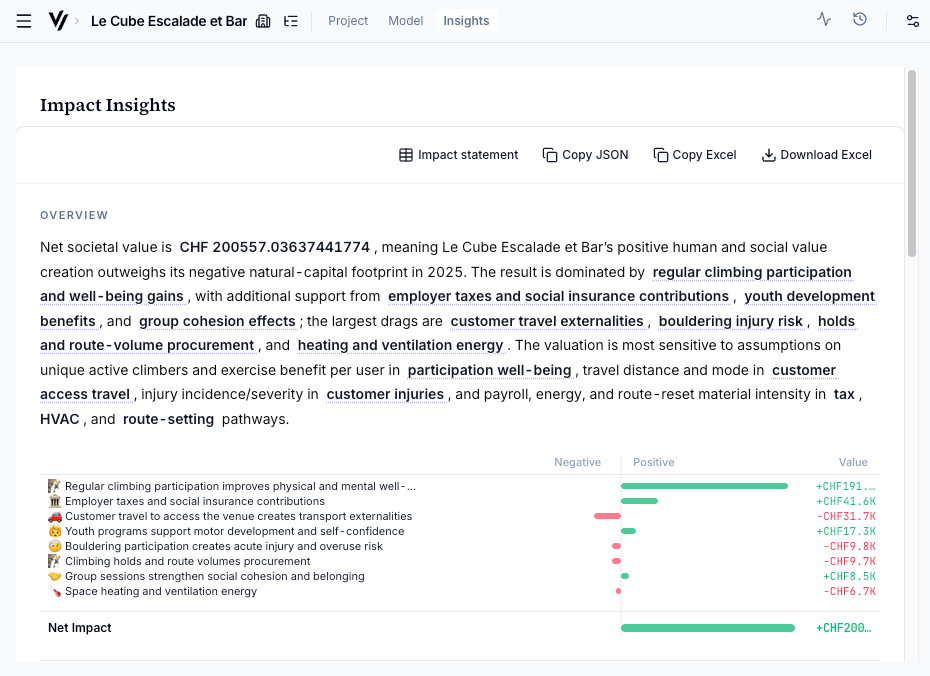
The top section is a narrative summary of the company's impact. It answers questions like: what are the main positive and negative outcomes, how significant are they, and where does the company make the most difference.
Projects also include a dedicated Statement page in the app navigation. Use it when you want a focused, print-friendly version of the impact statement and headline results.
Valuation chart
The chart visualizes every impact pathway the AI modeled, grouped by outcome type. Each bar represents a distinct pathway from a business activity to a monetized societal outcome.
Each pathway is valued using the eQALY framework, which converts diverse impact metrics into comparable monetary units through seven standardized outcome categories.
Key things to notice:
- Positive bars (right) represent beneficial impacts — value created for society.
- Negative bars (left) represent harmful impacts — costs imposed on society.
- Bar height reflects the magnitude in your chosen currency.
- Colors indicate the capital type affected: natural, human, or social capital.
SROI and IMOIC
Two headline ratios summarize the valuation:
| Ratio | What it tells you |
|---|---|
| SROI (Social Return on Investment) | Total societal value generated per unit of financial input (revenue, budget, or investment). An SROI of 3.2 means each dollar generates CHF 3.20 of societal value. |
| IMOIC (Impact Multiple on Invested Capital) | Societal value per dollar of invested capital. Useful for comparing impact efficiency across portfolio companies. |
These ratios are only meaningful in context. Compare them across your portfolio or against industry benchmarks, not in isolation.
Data challenges
The AI flags data points and assumptions you should verify with the company. This is your due diligence list — items where the model made assumptions that could significantly change the results if corrected.
Use this list when engaging with the investee. It tells you exactly what to ask for.
Validation review (beta)
The Validation tab turns data challenges and model checks into a review queue. Use it to inspect sources, activities, financials, variables, pathways, and quality signals in one place.
Typical review actions:
- Confirm items that are supported by reliable evidence.
- Flag items that need correction, better evidence, or company follow-up.
- Open linked variables, pathways, activities, or citations from the review row.
- Add notes so the review trail is clear for your team.
Risk and opportunity map
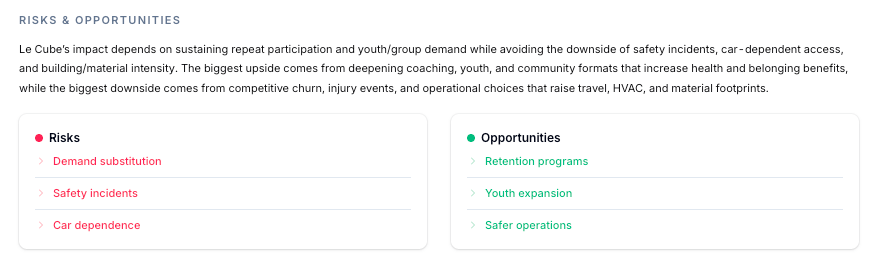
Identifies externalities and upside the company may not be managing. Risks are pathways where the company creates negative impact; opportunities are underexploited positive impacts.